Why Choose Us?
Professional Team
We possess a high-tech and well-trained team consisting of over 260 employees, among whom there are 80 engineering and technical personnel (5 senior engineers and 50 professionals with junior and intermediate titles) and more than 100 certified welders.
Advanced Equipment
In addition to the high-quality production supporting equipment, the company is equipped with advanced and perfect inspection and testing equipment, pressure leakage test equipment, physical and chemical equipment, and a welding laboratory, etc.
Complete Product Range
Our products include heat exchanger, separator, reactor, storage tank, tower, cryogenic equipment, filters, chemical and alumina evaporator.
Quality Control
The company has passed ISO: 9001 standard quality system certification, ISO14001 environmental management system certification, and ISO45001.
What Is Vertical Falling Film Evaporator
A vertical falling film evaporator is a vertically oriented shell and tube heat exchanger to concentrate solutions with different boiling point temperatures. Generally, the evaporation takes place inside the vertical pipes, but there are also applications where the process liquid evaporates outside the horizontal pipes. The evaporating process fluid flows downward in tubes by gravity in a continuous layer. The fluid will form a falling film along the sides of the tubes. To ensure the even distribution of the liquid in all pipes along which the solution falls, the liquid distributor must be carefully designed.

An alumina evaporator is a type of evaporator that uses alumina (aluminum oxide) as a desiccant or absorbent material.

A crystallizing evaporator is a type of equipment used in the process of evaporating a liquid to separate its components.

Six Effect Falling Film Evaporator
A six-effect falling film evaporator is a highly efficient and widely used industrial evaporator system designed to concentrate solutions and separate solvents from mixtures.

A falling film type evaporator is a type of evaporator commonly used in the food.

Multiple Effect Falling Film Evaporator
A multiple effect falling film evaporator is a type of evaporator used to concentrate or separate solutions by utilizing the heat generated from steam.

Vertical Falling Film Evaporator
Description A vertical falling film evaporator is a type of evaporator commonly used in the chemical and food processing industries.

Hybrid Falling Film Evaporator
A hybrid falling film evaporator is a type of evaporator that combines the features of both falling film and rising film evaporators to achieve efficient separation of liquid mixtures.

A forced circulation evaporator (FCE) is a type of evaporator used in the separation and concentration of liquid mixtures.
This design facilitates efficient heat transfer between the heating medium and the liquid to be evaporated. The liquid flows down as a thin film on the inner surface of the tubes, creating a large surface area for heat exchange. This efficient heat transfer ensures quick evaporation, minimizing residence time and resulting in higher productivity.
Vapor-liquid separators play a crucial role in the optimal performance of vertical falling film evaporators. These separators are strategically placed to separate the vapor and liquid phases, allowing for the collection of the concentrated liquid product. By effectively separating the two phases, vertical falling film evaporator ensure that the vapor is directed towards condensation, while the liquid flows down the tubes for further processing.
Advantages of a well-designed vertical falling film evaporator system are numerous. Firstly, the efficient heat transfer achieved by the falling film design reduces thermal degradation of sensitive products, preserving their quality. Additionally, the low tube wall temperature and heat flux contribute to energy efficiency, as it prevents fouling by reducing the chances of product buildup on the heated surfaces.
The high heat transfer coefficients of vertical falling film evaporator ensure rapid evaporation and increased productivity. Finally, the high vapor shear within the evaporator reduces foaming, enabling effective foam control during operation.
How Does a Vertical Falling Film Evaporator Work
Vertical falling film evaporators use a heat source such as electric heaters, or in our case heat pumps, to heat the solution until the lower boiling point liquid becomes gaseous and then uses a condenser to turn this separated gas back into a liquid which then becomes a recovered solvent.
Vertical falling film evaporators consist of vertical tube and shell exchangers, which is where the process takes place.
The boiling point for ethanol at the vacuum pressure we use is around 50°C, whereas the components of crude oil are much higher meaning that the oil can easily be separated from the solvent at high temperatures.
In the shell and tube heat exchanger design, a heat transfer liquid is heated and then used to heat the inside of the tube which contains the crude oil and solvent solution. Using this method allows for even heating of the solution so that most of the ethanol can be evaporated at a similar rate.
The vacuum draws the extract oil into a collection tube and the vaporized solvent into a condenser where it can be converted back into its liquid form and reused.
A vertical falling film evaporator comes after your extraction and winterization stages but before your decarboxylation and distillation stages. It takes an oil that has already had all the fats, waxes, and lipids removed and then further isolates the THC or CBD oil. After the extract has had the solvent recovered from it, it can be decarboxylated.
Decarboxylation occurs using heat to convert the THC-A and CBD-A molecules found naturally in the cannabis and hemp plant to the bioactive forms ready for consumption.
Benefits of Vertical Falling Film Evaporator
High efficiency: Designed to operate with a very high heat transfer rate, allowing for the evaporation of large quantities of solvent or water in a short amount of time. This makes them highly efficient for industrial applications, as they can save time and energy compared to other methods.
Reduced fouling: Create a thin film of liquid on the heat transfer surface, which minimizes the chance of fouling or scaling. This helps to maintain the heat transfer rate and prevent downtime due to cleaning or maintenance.
Versatile: Can be used for a wide range of applications, including concentrating solutions, separating components, and recovering solvents. They can be designed to handle different types of liquids, temperatures, and pressures, making them a versatile piece of equipment for many industries.
Environmentally friendly: Can be designed to operate at low temperatures and pressures, reducing energy consumption and minimizing the environmental impact. Additionally, they can be used to recover solvents or other valuable components, reducing waste and saving resources.
Applications of a Vertical Falling Film Evaporator
Vertical falling film evaporators are used in various industries to streamline processes and improve product quality. These units are particularly advantageous in managing temperature-sensitive substances due to their capability to operate under vacuum and at low temperatures, preserving the quality of delicate materials.
● The food and beverage industry
In the food and beverage industry, vertical falling film evaporators concentrate fruit juices, dairy products, and liquid sugars, efficiently reducing water content while maintaining the integrity of the flavor and nutritional profile.
● The pharmaceutical industry
The pharmaceutical industry relies on this technology to condense active pharmaceutical ingredients, ensuring efficacy and safety in medicinal products. Additionally, the biochemical field utilizes these systems for solvent recovery and the concentration of vitamins and enzymes.
● The chemical industry
The chemical and petrochemical fields also deploy falling film technology, relying on its continuous operation and consistent distribution of feed flow to maintain precise temperature control during evaporation.
● Additional industries
Each industry requires specific modifications to the vertical falling film evaporator design to align with unique process parameters, such as material compatibility, evaporation rate, and contamination prevention. By modifying the composition of the evaporative elements, such as using specialized alloys or coatings, the systems adapt seamlessly to the challenges presented by different materials and production environments.
Functioning of Vertical Falling Film Evaporators
The operation of the vertical falling film evaporators is based on the recovery of the condensation heat from the distillate as a source of heat to evaporate the feed.
In these systems, the process starts with the external energy supply to the evaporator to start the falling film evaporation process. The operation of the vertical falling film evaporators is based on the recovery of the condensation heat from the distillate as a source of heat to evaporate the feed.
The steam produced is extracted and compressed by a volumetric compressor with the intention of increasing its temperature. This superheated steam is then returned to the evaporator as a heating fluid. Once the cycle has begun, no more external heat input is required, as the mechanical compression of the steam provides enough heat to maintain the evaporation of the liquid.
Upon passing through the exchanger of the evaporator itself, this compressed, and therefore superheated, vapor has two effects:
1. It heats the liquid to be evaporated.
2. It condenses, thereby reducing the need for a refrigeration fluid.
The main advantage of vertical falling film evaporators lies in the fact that the energy consumption of the volumetric compressor is lower than the cost of producing steam for multi-effect evaporation systems. However, the volume to be evaporated must be high enough so that the saving generated compensates for the investment in the volumetric compressor.
Falling film mechanical vapor compression evaporators consist of a housing and tubes. The product circulates through the interior of the tubes and the steam through the housing, heating its outer walls.
The effluent enters at the top and slides uniformly through the tubes by gravity in the form of a thin layer which is heated by contact with the inner wall.
This equipment can also work with low temperature differences due to the high coefficients of thermal transfer obtained.
Design of Vertical Falling Film Evaporator
A vertical falling film evaporator is a type of industrial equipment used for the concentration of a liquid solution or the purification of a liquid by removing unwanted components. The basic design of a vertical falling film evaporator consists of the following components:
Heat exchanger: The liquid solution is pumped into a heat exchanger, which is usually a tube bundle. The heat exchanger is heated by steam, hot oil, or another heating medium.
Distributor: The distributor is located at the top of the heat exchanger and is used to evenly distribute the liquid solution over the heat exchange surface. This can be achieved using a series of nozzles, sprays, or by a specially designed distribution plate.
Film-forming section: The liquid solution flows down the heat exchange surface, forming a thin film. The film can be controlled by adjusting the flow rate and the angle of the heat exchange surface. The film-forming section is usually designed to maximize the surface area available for heat transfer while ensuring a uniform flow of the liquid solution.
Vapor separation section: The heat exchanger is designed to allow the vapor to escape from the liquid solution as it flows down the heat exchange surface. A vapor separator located at the bottom of the heat exchanger is used to separate the vapor from the liquid solution.
Condenser: The vapor is condensed in a separate condenser, which can be a shell and tube or plate heat exchanger, and collected as a concentrated liquid or as a vapor stream.
Product collection system: The concentrated liquid is collected and removed from the system via a separate collection system.
Zhangjiagang Changshou Industrial Equipment Manufacturing Co., Ltd
The company has a registered capital of RMB 80 million and a production base area of 35,000 square meters., and a high-tech and well-trained team of more than 260 employees, including 80 engineering and technical personnel (5 senior engineers and 50 professionals with junior and intermediate titles) and more than 100 certified welders. These employees have the extensive experience in the manufacturing and installation of pressure vessels and the on-site manufacturing of large equipment. In addition to the high-quality production supporting equipment, the company has the advanced and perfect inspection and testing equipment, pressure leakage test equipment, physical and chemical equipment, welding laboratory and so on.


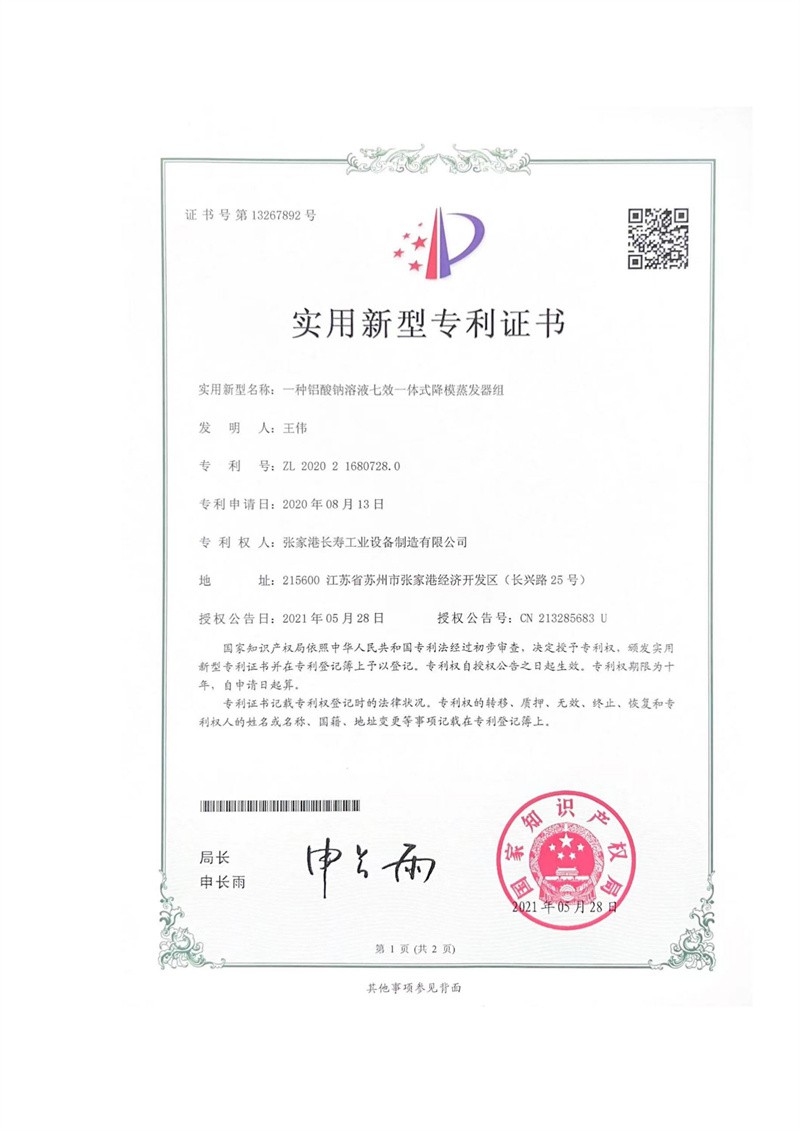
Our Certificate



FAQ
Hot Tags: vertical falling film evaporator, China vertical falling film evaporator manufacturers, suppliers, factory, evaporator for automotive industry, evaporator for wholesale industry, evaporator for aerospace industry, medium capacity evaporator, evaporator for chemical industry, evaporator with low energy consumption