


Why Choose Us?
Professional Team
We possess a high-tech and well-trained team consisting of over 260 employees, among whom there are 80 engineering and technical personnel (5 senior engineers and 50 professionals with junior and intermediate titles) and more than 100 certified welders.
Advanced Equipment
In addition to the high-quality production supporting equipment, the company is equipped with advanced and perfect inspection and testing equipment, pressure leakage test equipment, physical and chemical equipment, and a welding laboratory, etc.
Complete Product Range
Our products include heat exchanger, separator, reactor, storage tank, tower, cryogenic equipment, filters, chemical and alumina evaporator.
Quality Control
The company has passed ISO: 9001 standard quality system certification, ISO14001 environmental management system certification, and ISO45001.
What Is Stainless Steel Heat Exchanger
Stainless steel heat exchangers are devices that realize the heat transfer of liquids or gases. These devices are often used in industrial plants, heating, cooling and air conditioning systems. They save energy by utilizing the temperature difference between two fluids.

Stainless Steel Thin Wall Bellows Heat Exchanger
Stainless steel thin-wall bellows heat exchanger is a kind of high efficiency heat exchange equipment.

Spiral tube heat exchanger is a high-efficiency heat exchange equipment, which consists of two or more spiral shaped channels.

Threaded tube heat exchanger is a kind of efficient heat exchange equipment.

Thin-Wall Titanium Bellows Heat Exchanger
Thin-wall titanium bellows heat exchanger is an efficient and corrosion-resistant heat exchange equipment.

Double Tubesheet Heat Exchanger
Double-tubesheet heat exchanger is a kind of high efficiency heat exchange equipment with unique structure and exquisite design.

Shell-and-tube heat exchangers are a common type of heat exchange equipment that consists of a series of tubes that are enclosed in a housing.

Tube bundle heat exchanger, also known as tube heat exchanger, is a heat exchange equipment widely used in chemical, petroleum.

Stainless Steel Heat Exchanger Tubes
Stainless steel heat exchanger tubes are crucial components in various industrial and HVAC (heating, ventilation, and air conditioning) systems.

A steam heat exchanger is a device used to transfer heat by means of a temperature difference between steam and another medium.
What Is The Role Of Stainless Steel In Heat Exchangers
Stainless steel in heat exchangers is an economically sound investment. Besides, it has been observed that it has drastically reduced the shutdown of operations owing to its durability and strength. Although there are six functions of a heat exchanger that describe the role of stainless steel.
● Resisting corrosion by cooling down the temperature of the water and other chemical fluids
● Preventing oxidation by maintaining higher resistance in temperature.
● Maintaining excellent heat transfer capabilities
● Preventing the material to break down because of excellent corrosion-resistant properties
● The product or process is not contaminated by corrosion
● Compared to aluminum and copper it doesn't leave behind debris and thus is easiest to clean.
A stainless steel heat exchanger is a structural component of a heat exchanger, typically composed of a stainless steel shell and tube bundle.
● Corrosion resistance: Stainless steel is a corrosion-resistant material that can withstand the corrosion, oxidation, and erosion of corrosive media such as acids and bases. This makes stainless steel heat exchangers suitable for environments handling corrosive substances.
● Strength and pressure resistance: Stainless steel has high strength and pressure resistance, making stainless steel heat exchangers perform well under high-pressure conditions, and suitable for applications requiring high-pressure resistance.
Hygiene
Stainless steel surfaces are smooth and easy to clean, meeting hygiene standards. This makes stainless steel heat exchangers suitable for industries with high hygiene requirements, such as food and pharmaceuticals.
High-temperature resistance
Stainless steel exhibits good high-temperature stability and can operate in high-temperature environments without losing performance.
Wear resistance
Stainless steel has good wear resistance, making it suitable for applications where material durability is required.
A stainless steel heat exchanger is a special type of heat exchanger used in various industrial applications to efficiently transfer heat between two media. The term "tube bundle" refers to the arrangement of tubes in a heat exchanger, while "stainless steel" describes the material from which the tubes and other components of the heat exchanger are made.
The heat exchanger consists of an outer shell and an inner tube bundle. The inner tube bundle consists of an array of tubes arranged parallel to each other. One medium flows through the tubes inside the bundle (inner medium), while the other medium circulates outside the tubes in the shell (outer medium). During operation, heat exchange occurs between these two media, transferring heat from the warmer medium to the colder medium.

Stainless steel heat exchanger efficiency can be defined in many ways, in terms of thermal performance there are several key factors to consider:
Temperature differential: The difference between the hot fluid and coolant is very important when designing a stainless steel heat exchanger. The coolant always needs to be at a lower temperature than the hot fluid. Lower coolant temperatures will take more heat out of the hot fluid than warmer coolant temperatures. If you had a glass of drinking water at room temperature for example, it is much more effective to cool it down using ice rather than just cool water, the same principle applies to stainless steel heat exchangers.
Flow rate: Another important factor is the flows of the fluids in both the primary and the secondary side of the stainless steel heat exchanger. A greater flow rate will increase the capability of the exchanger to transfer the heat, but a greater flow rate also means greater mass, which can make it more difficult for the energy to be removed as well as increasing velocity and pressure loss.
Installation: The stainless steel heat exchanger should always be installed based on a manufacturers' guidelines. Generally speaking the most efficient way to install a stainless steel heat exchanger is with the fluids flowing in a counter-current arrangement (so if the coolant is travelling left to right, the hot fluid travels right to left) and for shell and tube stainless steel heat exchangers the coolant should enter at the lowest inlet position to ensure that the stainless steel heat exchanger is always full of water. For air cooled stainless steel heat exchangers it is important to consider the air flow when installing a cooler, any part of the core which is blocked will compromise cooling capacity.
Components of a Stainless Steel Heat Exchanger
Aside from the shell and tubes, other essential components of a stainless steel heat exchanger are
Tube sheet: The tubes are secured by inserting them into holes in a plate known as a tube sheet. The tubes extend through the tube sheet to direct the inlet and outlet flow of the process fluid. The pitch, which is the distance between the tubes, is typically 1.25 times the tube's outer diameter and can be arranged in either a triangular or square pattern.
Plenums: Plenums are located in both tube fluid inlet and outlet. It is a container wherein the tube fluid is gathered before loading and discharge.
The tubes are secured by inserting them into holes in a plate known as a tube sheet. The tubes extend through the tube sheet to direct the inlet and outlet flow of the process fluid. The spacing between the tubes, known as the pitch, is typically 1.25 times the outside diameter of the tube and can be arranged in either a triangular or square pattern.
Turbulator: The turbulator is a device that induces high velocity of the tube fluid and subsequently prevents fouling of the tubes while at the same time increasing heat transfer capacity.
Impingement plate: This plate is located directly below the shell fluid inlet. It absorbs shock and vibration to protect the top row tubes as the shell fluid is introduced with a high initial velocity.
Plate heat exchangers: These types of heat exchangers utilize conductive plates to transfer heat between two fluids. They have a counter-current flow that allows for lower approach temperature differences, high temperature exchanges, and improved efficiency.
Plate and frame heat exchangers: Plate and frame heat exchangers utilize corrugated plates joined by gaskets, welding, or brazing to prevent fluid mixing. The plates feature inlet and outlet ports at the corners for fluid passage. The flow paths for the fluids are the spaces between the plates, arranged in alternating hot-cold-hot-cold streams. The fluids flow in a countercurrent configuration, with the hot fluid moving downward through the plates and the cold fluid flowing upward.
How Do Stainless Steel Heat Exchangers Operate
Stainless steel heat exchangers are thermodynamic devices that enable efficient heat transfer between fluids or between a fluid and a solid surface: They operate based on several thermodynamic principles and equations we will review below.
Thermodynamics Principles of stainless steel heat exchangers
A fundamental equation governing heat transfer (HT) Q is Newton's Law of Cooling, given by Q = h × S × ΔT where h is the overall heat transfer coefficient, and S is the surface area available.
The overall heat transfer coefficient h considers various resistances to heat transfer, such as conduction, convection, and radiation. It depends on the materials' thermal conductivities, the walls' thickness, and the fluids' flow rates.
Stainless steel heat exchangers employ the principle of energy conservation, represented by the first law of thermodynamics. This law states that the energy entering a system must equal the energy leaving it. In the case of a stainless steel heat exchanger, the energy transferred as heat from the hot fluid equals the energy gained by the cold fluid.
Different types of stainless steel heat exchangers utilize specific flow patterns to optimize heat transfer. For example, in a parallel flow stainless steel heat exchanger, both fluids enter at one end, and hot and cold liquids travel parallel to each other, resulting in a gradual ΔT reduction along the length of the exchanger. In a counterflow stainless steel heat exchanger, the hot and cold fluids enter opposite ends, maximizing the ΔT and enhancing transfer.
Effectiveness
Efficiency is a crucial consideration in stainless steel heat exchanger operations. The effectiveness ε of a stainless steel heat exchanger is defined as the ratio of actual HT to the maximum possible HT. It can be calculated using the equation ε = Qₐ / Qₘₐₓ where Qₐ is the actual HT observed, and Qₘₐₓ is the maximum transfer of heat possible based on the ΔT between the fluids.
Engineers consider parameters such as fluid flow rates, properties, and design features to optimize stainless steel heat exchanger performance. Increasing surface area, using fins or turbulators, and employing materials with high thermal conductivity can enhance heat transfer.
Tips for Choosing the Right Stainless Steel Heat Exchanger Size
There are many different applications for stainless steel heat exchangers, and each one is unique. The size of the stainless steel heat exchanger that you need depends mainly on your application and how much heat can be transferred. The stainless steel heat exchanger size should also be considered with other factors such as pressure drop and required temperature change. People need to choose the right stainless steel heat exchanger size, which can lead to higher energy costs and less efficiency.
● Analyze your heat transfer requirements
When determining the appropriate stainless steel heat exchanger size, you must first select the heat transfer coefficient of your fluid. The heat transfer coefficient measures how much energy is transferred from one substance to another per unit area, pressure, and temperature difference between them. It's important to understand that different fluids have different specific heat capacities and therefore require different pressure drop levels for adequate cooling.
● Calculate the volume of your tank or reactor
First, you'll need to calculate the volume of your tank or reactor. This is important because it affects your system's heat transfer and pressure drop. The simplest way to determine volume is by measuring its outer dimensions. Still, if this isn't possible (for example, if you're working with a cylindrical vessel), then you can use an iterative process called "geometric averaging" (which involves calculating an average of the cross-sectional area) instead.
● Consider cost versus capacity
Cost is always important when buying equipment, but you may also need to consider how much capacity you need. If your application requires a large amount of heating or cooling, it's more economical to purchase a larger unit with more power than multiple smaller units.
It is possible-and often recommended-to save money by purchasing an oversized stainless steel heat exchanger: Look for one that's 30%–40% larger than what's required so that excess heat can be recycled back into the process loop or stored in tanks for later use (this is called "recovery"). However, keep in mind that this technique only works if there's plenty of free space available within the system boundaries; otherwise, there will be no room left over from which recovery could take place!
● Know your construction material options
Material is an important factor when choosing a stainless steel heat exchanger. Consider what you need the heater to do, and then select a material that will meet your requirements.
Stainless steel is the most popular option because it's durable and easy to clean (if needed). It also costs less than other options like titanium or aluminum, which are much more expensive but have their advantages as well-like being lighter in weight, making them easier to install on large-scale projects like oil rigs or ships where weight reduction is critical for safety reasons.
Another advantage of stainless steel is that it's non-corrosive. This means it can withstand exposure to salt water and other chemicals used in industrial processes. It also won't rust like titanium or aluminum, which means you don't need to worry about regular maintenance or cleaning.
Zhangjiagang Changshou Industrial Equipment Manufacturing Co., Ltd
The company has a registered capital of RMB 80 million and a production base area of 35,000 square meters., and a high-tech and well-trained team of more than 260 employees, including 80 engineering and technical personnel (5 senior engineers and 50 professionals with junior and intermediate titles) and more than 100 certified welders. These employees have the extensive experience in the manufacturing and installation of pressure vessels and the on-site manufacturing of large equipment. In addition to the high-quality production supporting equipment, the company has the advanced and perfect inspection and testing equipment, pressure leakage test equipment, physical and chemical equipment, welding laboratory and so on.


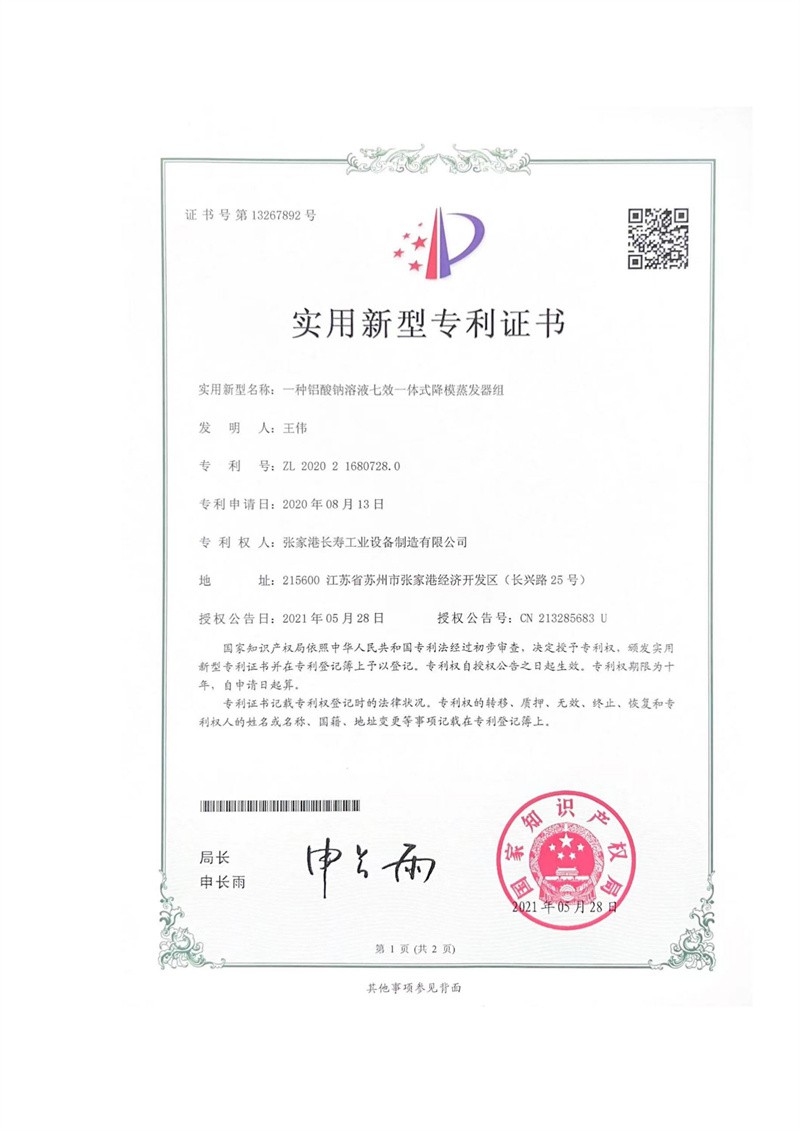
Our Certificate



FAQ
Hot Tags: stainless steel heat exchanger, China stainless steel heat exchanger manufacturers, suppliers, factory, storage tank, Liquid Storage Tank, Steel Reactor, Tube Bundle Heat Exchanger, Stainless Steel Pressure Reactor, Alumina Evaporator


