


Why Choose Us?
Professional Team
We possess a high-tech and well-trained team consisting of over 260 employees, among whom there are 80 engineering and technical personnel (5 senior engineers and 50 professionals with junior and intermediate titles) and more than 100 certified welders.
Advanced Equipment
In addition to the high-quality production supporting equipment, the company is equipped with advanced and perfect inspection and testing equipment, pressure leakage test equipment, physical and chemical equipment, and a welding laboratory, etc.
Complete Product Range
Our products include heat exchanger, separator, reactor, storage tank, tower, cryogenic equipment, filters, chemical and alumina evaporator.
Quality Control
The company has passed ISO: 9001 standard quality system certification, ISO14001 environmental management system certification, and ISO45001.
What Is Spiral Tube Heat Exchanger
A spiral tube heat exchanger is a type of heat exchanger that consists of two concentric spiral flow channels, allowing two different fluids to transfer heat between them. One channel handles the hot fluid, while the other is designed for the cold fluid.

Stainless Steel Thin Wall Bellows Heat Exchanger
Stainless steel thin-wall bellows heat exchanger is a kind of high efficiency heat exchange equipment.

Stainless Steel Heat Exchanger
Stainless steel heat exchanger is an efficient heat exchange equipment widely used in modern engineering applications.

Threaded tube heat exchanger is a kind of efficient heat exchange equipment.

Thin-Wall Titanium Bellows Heat Exchanger
Thin-wall titanium bellows heat exchanger is an efficient and corrosion-resistant heat exchange equipment.

Double Tubesheet Heat Exchanger
Double-tubesheet heat exchanger is a kind of high efficiency heat exchange equipment with unique structure and exquisite design.

Shell-and-tube heat exchangers are a common type of heat exchange equipment that consists of a series of tubes that are enclosed in a housing.

Tube bundle heat exchanger, also known as tube heat exchanger, is a heat exchange equipment widely used in chemical, petroleum.

Stainless Steel Heat Exchanger Tubes
Stainless steel heat exchanger tubes are crucial components in various industrial and HVAC (heating, ventilation, and air conditioning) systems.

A steam heat exchanger is a device used to transfer heat by means of a temperature difference between steam and another medium.
How Do Spiral Tube Heat Exchangers Work
Spiral tube heat exchangers are circular units containing two concentric spiral flow channels, one for each fluid. The different media flow counter currently: One fluid enters the centre of the unit and flows towards the periphery, the other enters the unit at the periphery and moves towards the centre. The channels are curved and have a uniform cross section. There is no risk of intermixing.
The product channel is normally open on one side and closed on the other. The channel for the heating/cooling medium can sometimes be closed on both sides, depending on the cleanliness of the heating/cooling medium. Each channel has one connection in the centre and one on the periphery of the heat exchanger.
● Energy saving
The spiral design and optimization of conditions in both channels of the spiral tube heat exchangers provide a high heat transfer value (k value) which leads to big savings in energy costs.
● Low maintenance cost
Spiral tube heat exchangers are designed to maximize heat transfer surface. They can be set up vertically or horizontally with no need for complex installation. In addition maintenance costs are very limited.
●Compact size and robustness
Regarding the liquid to liquid duty, one spiral tube heat exchanger can replace 3 traditional shell & tubes products, releasing footprint for the process part.
● Self cleaning effect
Thanks to the single channel configuration, a turbulent flow is created to handle tough medias. Since it is a single channel heat exchanger, if there is any cross section reduction inside the channel, flow velocity will increase flushing out the deposit.
● No dead zones in the channels
Thanks to its defined cross section uniform from the beginning to the end of the spiral core combined with turbulent flow, the spiral heat exchanger technology is considered as a no dead zone heat exchanger in the channel flow.
● Full access to heat transfer area
Access and inspection of the whole heat transfer surface is facilitated thanks to openable end covers.
● Fouling / erosive / corrosive medias
Spiral tube heat exchangers are designed to handle suspended fibers / particles in the media. When it comes to erosive and / or corrosive medias, we propose some adapted features to handle it.
● Temperature approach
Spiral tube heat exchangers provide the possibility of medias temperatures approach around 3°C.
● Heat transfer area surface
The heat transfer area available for a liquid to liquid exchanger fluctuates from 2 to 700m².
Spiral Tube Heat Exchanger Applications
Spiral tube heat exchangers are a type of heat exchanger that is designed to transfer heat between two or more fluids which are separated by a solid wall. These exchangers consist of a series of plates that are arranged in a spiral pattern, which allows for efficient heat transfer even with high viscosity fluids. Due to their unique design, spiral tube heat exchangers are incredibly versatile and can be used in a variety of applications.
The primary application of spiral tube heat exchangers is in the chemical and petrochemical industries. Here, they are used in a wide range of processes, including heating and cooling, condensation, and evaporation. In the chemical industry, spiral tube heat exchangers are extensively used in distillation columns, where they are used to preheat and cool the feed and product streams. Similarly, in the petrochemical industry, spiral tube heat exchangers are used in refineries to heat or cool the crude oil and separate the various components using distillation.
Another common application of spiral tube heat exchangers is in the food and beverage industry. Here, they are used for a variety of tasks, including pasteurization, sterilization and evaporation. For example, in the dairy industry, spiral tube heat exchangers are used to pasteurize milk and other dairy products, while in the fruit juice industry, spiral tube heat exchangers are used for juice concentration and evaporation. They are also used for heat recovery in these industries, which help in reducing the overall energy consumption and cost.
Spiral tube heat exchangers are also used in the HVAC (Heating, Ventilation, and Air-Conditioning) industry. Typically, these exchangers are used in large commercial and industrial buildings that require efficient heating and cooling systems. In such systems, the spiral tube heat exchangers are used to transfer heat between the building's HVAC system and the outside air or water systems. They are also used in geothermal heating and cooling systems, which use the earth's natural temperature to transfer heat and cool the building.
The pharmaceutical and biotech industries are another area where spiral tube heat exchangers are widely used. Here, they are used for sterilization, purification, and fermentation. In these industries, it is essential to maintain a sterile environment, and spiral tube heat exchangers can help achieve this by providing a high level of heat transfer efficiency without contaminating the process.
In the paper and pulp industry, spiral tube heat exchangers are used for heating and cooling of various process streams.
They are also used in the recovery of heat from the black liquor, which is the spent pulping solution, and also in the chemical recovery process.
Spiral tube heat exchangers also find their applications in the marine and offshore industry. They are used for cooling of the engine, lubrication and hydraulic fluid and also for heat recovery from the exhaust gases.
Spiral tube heat exchangers are widely used in a variety of industries due to their high efficiency, compact size, and versatile design. They can handle a wide range of fluids, making them ideal for use in diverse applications. The chemical and petrochemical industries, food and beverage industry, HVAC industry, pharmaceutical and biotech industries, paper and pulp industry, and marine and offshore industry are some of the industries which widely use spiral tube heat exchangers. The applications of these heat exchangers are vast, and they continue to be an essential component in various processes across many industries.
How to Design a Spiral Tube Heat Exchanger
Analysing the Application
When we first receive an enquiry for a heat exchanger, the first step is to analyse the application. Is it a food industry application? Is it an industrial one? The design engineer must correctly define the type of heat exchanger that is necessary and will meet the requirements of the application.
The design temperature, pressure and maximum allowable pressure drop must be defined for the product and service fluids.
Identifying the Fluid Properties
The next step is to analyse the fluids or gases involved: the product side fluid and service side fluid. Four important physical properties of the fluids involved need to be known:
● Density
● Specific heat
● Thermal conductivity
● Viscosity
The Energy Balance
Once we have correctly defined the physical properties, it is time to check the energy balance. Normally the customer defines the product's flow rate and the desired entry and exit temperature. They will indicate the type of serviced fluid to be used and define two of the following three parameters: service flow rate, service entry temperature or service exit temperature. With two of these known, the third parameter is calculated.
Defining the Geometry of the Heat Exchangers
In this step, the design engineer defines the geometry of the heat exchanger. He will choose the shell diameter and will define the tube bundle that is placed inside the heat exchanger: nr of inner tubes, inner tube diameter and wall thickness and the length of the inner tubes. Secondly, the dimensions of the shell and tube side fluid connections are defined.
Thermal Calculation
At this stage, the design engineer performs a thermal calculation. The objective is to obtain the shell and tube side heat transfer coefficients. These coefficients depend on the four key fluid parameters and the velocity of the fluid. The relation between the parameters and the heat transfer coefficients is defined in a mathematical formula that is specific to the geometry (i.e. the type of heat exchanger used: tubular, plate, corrugated tube).
With the shell and tube side coefficients known, the overall heat transfer coefficient can be calculated. Knowing this value, it becomes possible to calculate the total heat transfer area needed for the application:
● Area=Duty/[K×LMTD]
Where:
● Area: Total heat transfer area required, m².
● Duty: Total heat transferred, kcal/hr (derived from energy balance).
● K: Overall heat transfer coefficient, kcal/[hr.m².°C].
● LMTD: Log mean temperature difference, °C (the average logarithmic temperature difference between shell and tube side fluid over the heat exchanger length).
Another important parameter is the pressure drop, which is calculated for the shell and tube side fluids. The pressure drop is a function of the Reynolds number, the type of flow (turbulent or laminar flow) and the roughness value of the shell and inner tubes.
Interpretation of the Thermal Calculation
The calculated area is compared with the area defined in step four and a check is made to see if the pressure drops are within the design limits. If the calculated area exceeds the predefined area, the geometry of the heat exchanger needs to be redesigned, possibly by increasing the length or adding inner tubes.
Likewise, if the calculated pressure drop exceeds the maximum defined, then a new geometry must be designed to ensure a pressure drop reduction. Steps four to six are then repeated until a satisfactory design with suitable geometry is obtained.
Mechanical Design Calculations
With the heat exchanger geometry defined, the mechanical design calculations must be performed to ensure that the heat exchanger design is valid for the design pressure and conditions. The typical calculations are:
● Calculation of shell wall thickness.
● Calculation of nozzle wall thickness.
● Calculation of inner tube wall thickness.
Calculation of expansion joint dimensions (to compensate for shell and tube side differential expansion due to temperatures differences.
Calculation of tube sheet thickness.
Calculation of expansion joint dimensions (to compensate for shell and tube side differential expansion due to temperatures differences.
Calculation of tube sheet thickness.
The mechanical design calculations may result in wall thicknesses or other parameters that do not comply with the geometrical design defined in step 4. In this case, a new proposal for the geometry must be made and step 4 to 7 must be repeated.
Preparation of the Manufacturing Drawings
With all dimensions of the spiral tube heat exchanger defined, the manufacturing drawings can be prepared. The drawing package contains details of the various components of the heat exchanger, including shell; tubes, expansion joints, connections, etc.
How Do You Clean a Spiral Tube Heat Exchanger
During the course of its operating life, a spiral tube heat exchanger will need cleaning many times.
1. Removing the end covers gives access to the tube core, which can be removed from the body (or shell).
2. The tube plates and external tubes can then be washed using a handheld hose or lance. A steam cleaner can also be used, if available.
3. Small diameter rods or tube brushes can be used to clean through each tube to remove any stubborn deposits.
4. Detergents or chemicals can be used, if tube fouling is severe. Allow plenty of time for the cleaning media to work before hosing down with plenty of water. Note: It is important to check any cleaners being used are compatible with the tube material.
5. Thoroughly flush the tube core with clean water to remove all traces of cleaning chemicals/detergents and if necessary, neutralise the cleaning fluid.
6. Reassemble the tube core into the body, refit the end covers in their original orientation and tighten to the recommended torque figures – note: Always use new 'O' seals after cleaning to ensure a watertight joint.
Zhangjiagang Changshou Industrial Equipment Manufacturing Co., Ltd
The company has a registered capital of RMB 80 million and a production base area of 35,000 square meters., and a high-tech and well-trained team of more than 260 employees, including 80 engineering and technical personnel (5 senior engineers and 50 professionals with junior and intermediate titles) and more than 100 certified welders. These employees have the extensive experience in the manufacturing and installation of pressure vessels and the on-site manufacturing of large equipment. In addition to the high-quality production supporting equipment, the company has the advanced and perfect inspection and testing equipment, pressure leakage test equipment, physical and chemical equipment, welding laboratory and so on.


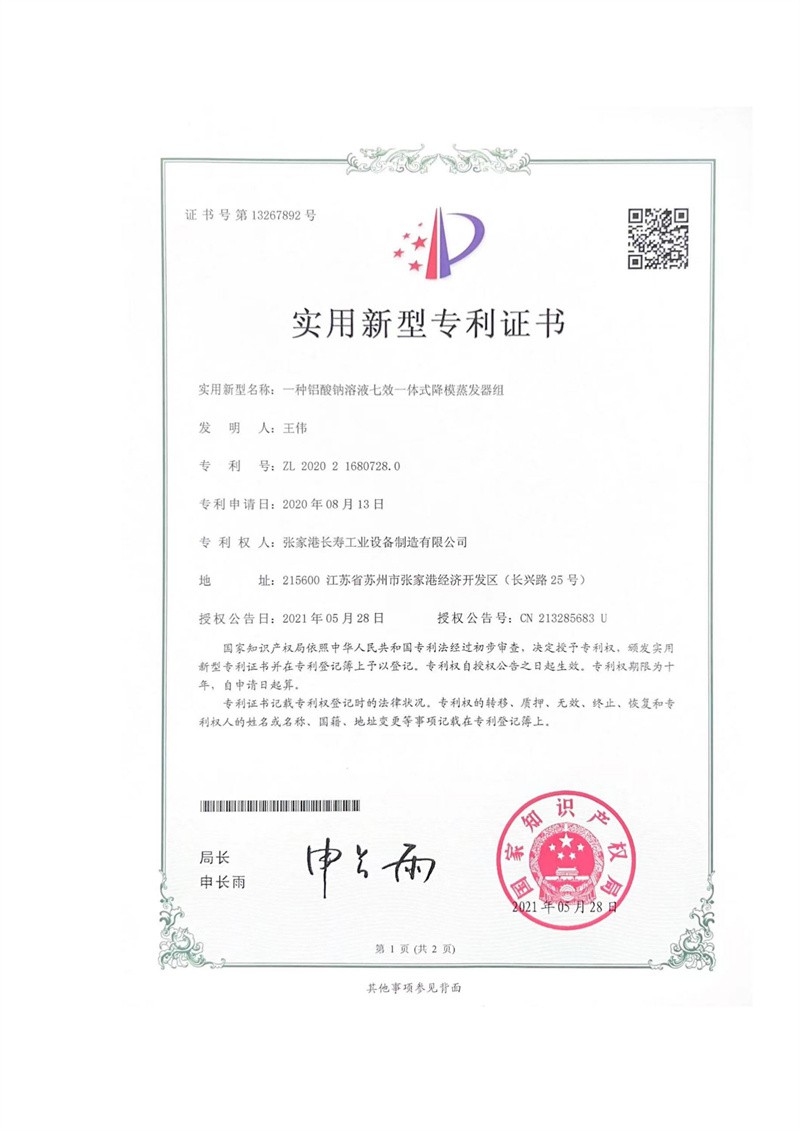
Our Certificate



FAQ
Hot Tags: spiral tube heat exchanger, China spiral tube heat exchanger manufacturers, suppliers, factory, heat exchanger for fuel cell cooling, heat exchanger for retrofit, heat exchanger for industrial cooling, heat exchanger for fitting systems, heat exchanger for hydroponics, Threaded Tube Heat Exchanger


