


Why Choose Us?
Professional Team
We possess a high-tech and well-trained team consisting of over 260 employees, among whom there are 80 engineering and technical personnel (5 senior engineers and 50 professionals with junior and intermediate titles) and more than 100 certified welders.
Advanced Equipment
In addition to the high-quality production supporting equipment, the company is equipped with advanced and perfect inspection and testing equipment, pressure leakage test equipment, physical and chemical equipment, and a welding laboratory, etc.
Complete Product Range
Our products include heat exchanger, separator, reactor, storage tank, tower, cryogenic equipment, filters, chemical and alumina evaporator.
Quality Control
The company has passed ISO: 9001 standard quality system certification, ISO14001 environmental management system certification, and ISO45001.
What Is a Compressed Air Storage Tank
An compressed air storage tank: A tank that receives and stores compressed air after it exits the air compressor. This gives you a reserve of compressed air that you can draw on without running your air compressor.
An air receiver is a type of pressure vessel; it holds compressed air under pressure for future use. The tanks come in a range of sizes and in both vertical and horizontal configurations.

Diesel storage tanks are specialized containers designed for the safe storage of diesel fuel.


Oil storage tanks are large, specialized containers designed to store crude oil or refined petroleum products safely and efficiently.

A gas storage tank with a pump is a system designed to store and transport gases safely and efficiently.

A hydrogen storage tank is a specialized container designed to store hydrogen gas safely and efficiently.

Stainless steel storage tanks are durable and corrosion-resistant containers used for storing various liquids.

Carbon steel storage tanks are large containers designed to store various substances.

A compressed air storage tank, also known as a compressed air energy storage (CAES) system, is a device used to store compressed air for later use. It's a way to store energy in the form of compressed air, which can be used to generate electricity when needed.
Benefits of Having an Compressed Air Storage Tank
● Maintain constant pressure: Air compressors use pistons or screw elements to create pressurized air. The piston operates in up and down or the screws in a rotary motion to compress air and release it. The cyclical operation that delivers compressed air in pulses can be challenging when it comes to long-term use. A tank dampens the pulsation, improving the flow of compressed air and at constant pressure. Uniform airflow ensures reduced wear and tear on your compressor.
● Store compressed air: Compressed air storage tanks are reservoirs of compressed air. They are available in a wide range of sizes and work with virtually any compressor type. Having an apt compressor tank helps you meet peak demand while ensuring enough supply for dependable and continuous air delivery.
● Prevents wear and tear: Compressor motors activate automatically when the system senses a need for air. If you run a system without a tank, the motor will end up working over a longer period of time to meet the air demand. Compressor tanks provide the support a system needs to reduce cycles and prevent excessive loading and unloading of air into the system. It makes sure that there isn't excessive wear and tear of components and ensures that your system is cost and energy efficient.
● Removing condensation: Atmospheric air contains water as vapor. Water vapor often contains traces of impurities like dust and oil. In the longer run, when your system compresses air, these vapors will cool down and the condensation will end up in your system. As the contaminants build, the system performance goes down. This will eventually lead you to replace the unit. Tanks collect this condensation into moisture traps that you can quickly drain.
There are three main options when it comes to the internal lining of your tank.
1. Bare steel interior with primer exterior (typical)
2. Epoxy coated or galvanized interiors
3. Stainless steel
● Steel compressed air storage tanks
The majority of compressed air storage tanks are bare steel on the inside with a primer coating on the outside to reduce corrosion. The exterior paint is commonly matched to the compressor equipment. A basic steel tank works well for most applications and is the least expensive option. However, they may be prone to corrosion if too much liquid is allowed to build up inside the tank.
● Epoxy coated and galvanized compressed air storage tanks
Some compressed air storage tanks have treated interior linings to reduce corrosion and maintain air quality. These liners fall into two categories.
Epoxy coatings are sprayed onto the interior as a liquid and then cured into a tough, anti-corrosive coating. Epoxies work by creating a moisture-proof barrier between the air and the base metal of the tank.
Galvanized tanks are treated with a protective zinc coating that halts the formation of rust. Zinc protects the base metal by reacting chemically with corrosive agents before they can reach the base.
Both methods provide long-lasting protection for the interior of the tank, but they do add to the cost and lead time. Coated or galvanized tanks are better at maintaining air purity because they reduce the risk of particulates caused by corrosion entering the airstream. Applications needing higher purity air, or users concerned about the longevity of their air tanks, may want to consider one of these options.
● Stainless steel compressed air storage tanks
Stainless steel compressed air storage tanks are primarily used for specialty applications where very high-purity air is required. They are the most expensive option, but they are highly durable and corrosion-resistant and maintain exceptional air purity.
Steps to Replacing an Compressed Air Storage Tank
Power off
The first and most important step is to turn off and unplug the air compressor. Remove any power cords that could turn on the air compressor and remember that safety should be your primary concern. Always double-check that the compressor is completely powered down before proceeding with any maintenance tasks.
Drain the tank
Next, release the drain valve located at the tank bottom to get rid of any residual moisture or air. Allowing the tank to fully drain will ensure a safer and simpler disconnection process.
Disconnect the old tank
Once emptied, use the right tools to disconnect the old tank and detach any drain valves, hoses, pipelines, wires, and pressure switches. Be very mindful of the electric motor wires and mark or photograph their positions to aid with reassembly. Take care to inspect the condition of all components for any signs of wear or damage that may need attention during the replacement process.
Remove the old tank
This stage might need some muscle. Compressor tanks, particularly the larger gallon tanks, can be heavy. Be sure to lift properly or use equipment aid like a dolly to avoid injury. Take your time during this step to ensure the old tank is removed safely and without causing damage to surrounding equipment or structures.
Install the new tank
Position the new air tank and carefully reconnect all drain valves, hoses, pipelines, wires, and pressure switches, ensuring that the new tank is oriented correctly. Double-check all connections to ensure they are secure and properly tightened to prevent any leaks or malfunctions once the compressor is back in operation.
Test before final use
Before you begin using your new compressor tank, ensure that everything's been installed correctly. Turn the power on, allow it to pressurize, and watch for leaks or other issues.
Wet Vs. Dry Compressed Air Storage Tanks
Compressed air can also be stored "wet" or "dry," with wet storage tanks located before the air drying system and dry tanks located after the dryers.
The big advantage of dry storage is that it offers compressed air ready for use right out of the tank. That reduces the risk that high-demand events will push demand beyond the air dryer's capacity.
Wet storage allows excess water and lubricant to condense out of the system before it hits the filter and dryer. It thus increases your air dryer's energy efficiency and prolongs the life of the pre-filter element. Plus, it eliminates the pressure drop on the air dryer side of the system that occurs with dry storage. Wet tanks are very important for desiccant dryer systems due to the large amount of air used when the towers switch.
A critical component for the wet tank is to ensure you have a working drain trap to drain the moisture and contaminants the wet tank captures. It's a good idea to use a no-loss drain to ensure you do not waste the stored compressed air.
Most facilities have a combination of wet and dry storage, with a third of storage capacity as wet storage and two-thirds dry.
Since rust causes irreversible damage to air tanks, prevention is the best way to keep your tank healthy and yourself safe. The most effective way to prevent rust in your air tanks is to drain each tank regularly after every operation. This process helps eliminate the condensation that's pooled at the bottom of the tank. After draining, leaving the valve open for a couple of hours will allow the inside of the tank to dry out.
Another way to help prevent rust is with the addition of an aftercooler. Aftercoolers attach to your air tank to stop water vapor before it enters the tank. An aftercooler acts as a filter that gathers warm air and cools it down. This technique prevents moisture from occurring in the first place and helps eliminate the heat that detrimentally affects equipment sealing and lubrication. For optimal effect, your aftercooler should be attached as closely as possible to the discharge of the compressor.
No matter what equipment you use to keep your air compressor rust-free and safe, always make sure to keep routinely checking the vessel for water and rust. Even if you have an aftercooler, you should still check the tank for vessel integrity to uphold the highest safety standards possible.
Purpose of Compressed Air Storage Tank
Offers energy storage
The receiver tank can work as a temporary storage space for the compressed air until you decide what to do with it. The stored compressed air can be used during emergencies and the receiver tank can function as a supply tank in such situations. Having a receiver tank is not just a place to store the extra energy but it also works as a backup if there is sudden demand or there is increase in demand, or something goes wrong at the end of the compressor.
Works as a stabilizer
When the demands of compressed air are not stable, the pressure goes on the compressor. It requires temporary shutdowns repeatedly and that not only leads to wastage of energy but also hinders the performance and productivity of the compressor.
Having a receiver tank makes it easy to stabilize the process as sudden demands can be met from the stored energy and the compressor can be given some rest or can be used in fixed cycles which will lead to efficient results.
Improves energy efficiency
Turning the compressor on and off again and again creates too many duty cycles for the compressor and all this leads to wastage of energy. Having a receiver tank prevents such situations and thus helps in improving energy efficiency. The power that is going wasted in maintaining various cycles can be used for meaningful cycles that will add to the productivity of the system.
Improves dryers' efficiency
Using a receiver tank before the dryer can reduce the work for the dryers. The receiver tank can help in cooling off the compressed air by working as a heat exchanger. The cool air loses a part of moisture it contains and it condenses in the receiver tank before reaching the dryer. The condensed moisture runs out of the valve at the bottom of the receiver tank which eventually makes the air a little dry. Thus, the job of the dryer is reduced when the air is first stored in a storage tank.
Reduces load on filters
The removal of the moisture from the compressed air in the storage tank is also beneficial for the coalescing filters. The moisture that condenses and gets removed as water makes the air dry and that works great for the filters. The air is dryer than it is when freshly compressed. When the air passes through the filters, less moisture accumulates on the filters and that's beneficial for the overall working of the filters. Thus, having a storage tank can reduce some load on filters as well.
Zhangjiagang Changshou Industrial Equipment Manufacturing Co., Ltd
The company has a registered capital of RMB 80 million and a production base area of 35,000 square meters., and a high-tech and well-trained team of more than 260 employees, including 80 engineering and technical personnel (5 senior engineers and 50 professionals with junior and intermediate titles) and more than 100 certified welders. These employees have the extensive experience in the manufacturing and installation of pressure vessels and the on-site manufacturing of large equipment. In addition to the high-quality production supporting equipment, the company has the advanced and perfect inspection and testing equipment, pressure leakage test equipment, physical and chemical equipment, welding laboratory and so on.


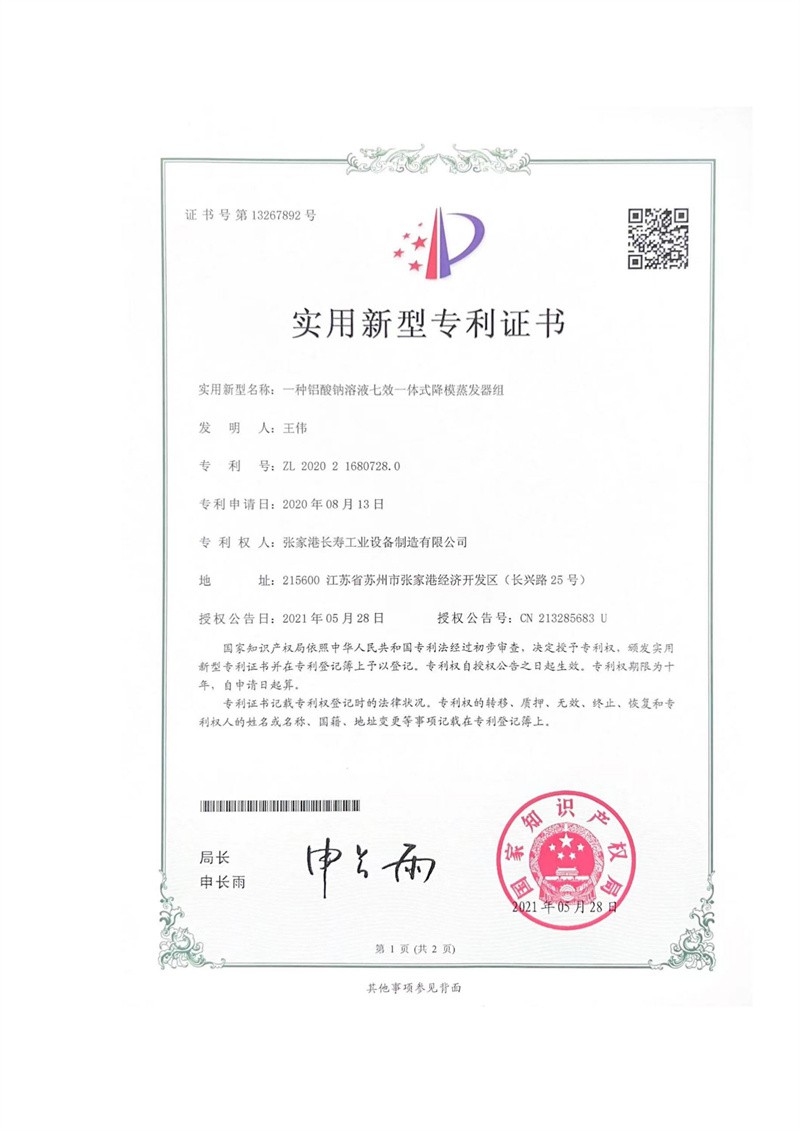
Our Certificate



FAQ
Hot Tags: compressed air storage tank, China compressed air storage tank manufacturers, suppliers, factory, Ss316 Reactor, Refinery Tower, Oil Storage Tanks, Film Evaporator, Stainless Steel Storage Tanks, Threaded Tube Heat Exchanger


